
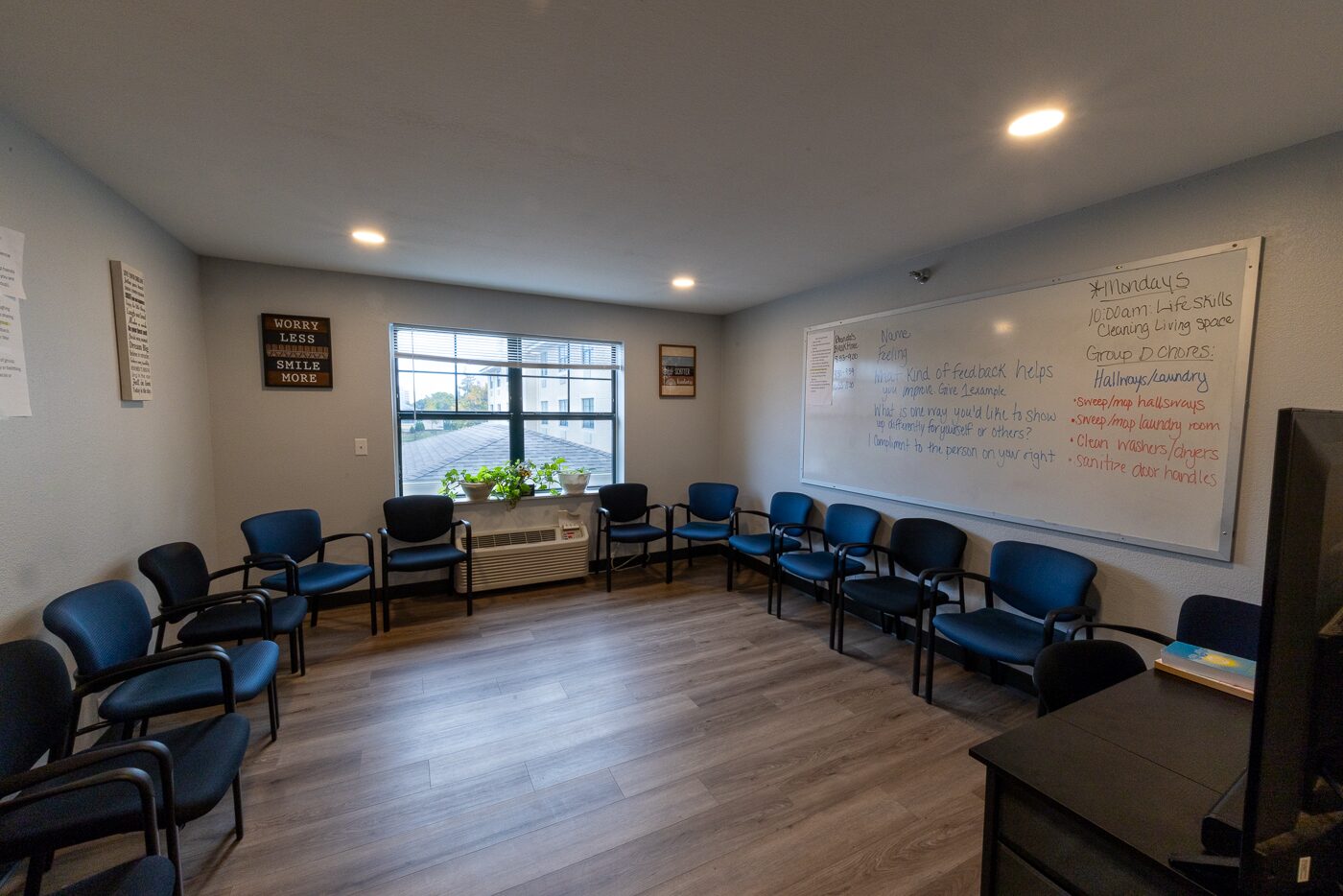
Cognitive Behavioral Therapy in Minnesota
CBT therapy in Minnesota is the workhorse of treatment at NorthStar Regional, used in groups and one-on-one at every level of care. Cognitive behavioral therapy works on one cycle: thoughts drive feelings, feelings drive actions, and actions confirm the thoughts. You learn to catch a harmful thought before a drink or a spiral, then choose the next move on purpose. The same pattern drives a craving and a depressive spiral, so one method targets both in one session. We accept Medical Assistance (Medicaid) and most major insurers, and the skills are yours to keep.
CBT at a glance
One triangle
Thoughts drive feelings, feelings drive actions, actions confirm thoughts
Learning with Purpose
You practice these steps until they become a habit, so they are ready when you are under pressure.
The homework is the therapy
Thought records. Trying new actions as a test. Small planned wins between sessions.
Sessions are the coaching
Going over the week, looking at specific thoughts and situations, and working on skills
Licensed Treatment Programs

Founded 2015
Addiction and mental health care in one system

Multiple Campuses
Across the Twin Cities metro

MN Department of Health: Licensed
MN Department of Human Services: Licensed
Understanding the therapy
What CBT Does
CBT works on a simple cycle. Your thoughts shape your feelings, your feelings shape what you do, and what you do seems to prove the thought was right. Addiction runs on that cycle (“I can’t handle this sober,” then dread, then a drink, then proof…). Depression and anxiety run on it too. CBT teaches you to catch the thought as it happens, question it, and choose what to do next on purpose.
It’s simple, and it works, which is why it’s a standard part of addiction treatment. At NorthStar Regional, you’ll use it every day in process groups, education sessions, one-on-one sessions, and the homework that turns what you learn into habits you can use under pressure.

Is this right for you?
Signs You Need CBT Services
CBT services are the right fit when the same thoughts keep leading to the same problems week after week. See if you recognize the pattern.
The Same Thoughts, Every Time
“I’ve already blown it.” “Nothing will change.” “I can’t feel like this sober.” The words vary, but the conclusion never does.
Feelings Feel Like Facts
A wave of dread arrives and your mind treats it as evidence. CBT teaches the difference between a forecast and a feeling.
Your Triggers Are Predictable
Paycheck Friday, the in-laws, a bad shift. You can predict your own relapses and spirals. That means they’re a pattern, not fate.
You Avoid More Every Month
Skipped calls, cancelled plans, roads not driven. Every avoided thing confirms the thought that made you avoid it.
You Can’t Think Straight During A Craving
In the moment, the case for using sounds airtight. You need a way to question it while the urge passes.
Knowing Why Isn’t Enough
You’ve understood your problems for years. What’s missing is a repeatable move for the moment it counts.
If even a few of these sound like you, that is reason enough to call. You don’t need to be certain, and you don’t need a diagnosis. A comprehensive assessment will sort out where this fits in your care. Reading this for someone you love? Start with our guide for parents or our guide for spouses and partners.
How It Helps
CBT Helps with Both Addiction and Mental Health Disorders
The same thought pattern that drives a craving also drives a depressive spiral. That is why CBT is central to dual diagnosis care, mental health and substance use treated together. One method works on both problems in the same session, instead of two separate referrals.
For Addiction
Every substance we treat is explained on its own page, from the first assessment through sober living.
For Mental Health
At designated NorthStar Regional programs, these conditions are treated together with addiction as co-occurring care, in one plan. Standalone mental health treatment, no substance use diagnosis needed, is available through our outpatient clinic in Shakopee.
What to expect
What CBT Looks Like Week to Week
Coaching, practice, repeat. The skills build on each other.
Daily Groups Put CBT Into Practice
In process groups and education sessions, you apply the thought-feeling-action cycle to real situations from your week. The people in your group know the pattern from their own lives.
The Thoughts That Hurt You Most
In individual sessions, you work on the thoughts that cause you the most trouble, like the reasoning that leads to relapse, 3am worries about what will go wrong, and all-or-nothing thinking.
What You Do On Your Own
You keep thought records, run behavioral experiments, and plan small wins on your own. That work between sessions is where the cycle starts to change.
Where You'll Find It at NorthStar Regional
CBT at Every Level of Care
CBT is not a program you enroll in. It is the method used inside every program.
Residential
Inpatient Rehab
Daily CBT-anchored groups at the residential level.
Outpatient
Intensive Outpatient and Virtual IOP
The same method at outpatient rhythm, in person or from home.
The long game
Relapse Prevention
CBT is the main tool in your plan for the bad days.
Treatment Options
Explore Our Addiction and Mental Health Therapies
Recovery rarely rests on one method. Below are the addiction and mental health therapies and services at NorthStar Regional. Each has its own page. Your comprehensive assessment, the full evaluation that sets your plan, decides which mix of therapies your plan starts with.
The therapies
The standalone services
Who's behind the work
About NorthStar Regional
NorthStar Regional is Minnesota’s treatment system built around access: alcohol and drug treatment centers and mental health care across multiple Twin Cities metro locations. Founded in 2015, we provide one connected continuum: detox (withdrawal management), residential, outpatient, mental health, and a sober housing pathway. Separate men’s and women’s campuses, co-occurring care at designated programs, and no faith requirement set us apart. We accept Medical Assistance (Medicaid) and most major insurers, and if you are uninsured, our admissions team helps you through enrollment. A person can walk in with nothing and leave with everything they need to build a life.
Paying for Care
Insurance and Payment Options
Our team helps review your benefits and handles the paperwork with you. If you have no insurance, we help walk you through enrolling for benefits. County case managers, probation officers, hospitals, and crisis teams send clients to us because, in their words, we just get it done.

Insurance and State Funding
Commercial plans, Medical Assistance (Medicaid), county placements, and private pay. We verify benefits and handle the paperwork with you.
We Are Here to Help
We help review your benefits, find your right starting point, and schedule you for the same day or the next whenever possible. Then we pick you up anywhere in the Twin Cities metro.


How Admission Works
What Happens From Your First Call to Your First Night
You did the hard part when you picked up the phone. Here is exactly what happens next, so nothing about day one is a mystery.
You Call and a Real Person Answers
A real person answers, usually within seconds, and asks one short question: substance use, or mental health? There is no phone tree, and you don’t have to tell your life story. We ask only what we need and handle the rest.
We Help with the Details
Our team helps review your benefits, and a short screening covers withdrawal risk, medical needs, and mental health, so you land at the right level of care. Then we schedule you, same day or next day whenever possible.
We Pick You Up
You get reminder calls and texts before pickup. For residential, your admissions coordinator and your driver also call you together, so you know who’s coming, what car to look for, and when to expect them. Many of our drivers are in long-term recovery themselves, and yours will help with your bags.
A Real Person Meets You When You Arrive
Your driver walks you inside and introduces you by name to the team member waiting for you. Your intake team completes your application with you. If you’re hungry, there’s a meal waiting. From there, treatment starts, and we help take care of the logistics along the way.

“The client has done the hard work by picking up the phone. We will carry them the rest of the way.”
Sarah Roy, Executive Vice President
Reviews from Google
Why Clients Choose NorthStar Regional
Don’t just take our word for it. Here is what alumni say about their time in treatment.
Keep reading
Related Articles and Resources


Resources
Before You Call
How admissions works, guides for families, and the forms you can complete early. More resources are linked throughout the site, or contact admissions and we’ll send anything by email.
Questions we hear every day
Common Questions About CBT
What is CBT?
Cognitive behavioral therapy is the most widely practiced talk therapy in the world. It is built on a simple cycle: thoughts drive feelings, feelings drive actions, and actions reinforce thoughts. Change one part of that cycle on purpose, and the other parts start to change too.
How does CBT help with addiction?
Cravings start with thoughts like “One won’t hurt,” “I’ve already blown it,” and “I can’t feel like this sober.” CBT teaches you to notice those thoughts as they happen and test them against what is real. Then you choose a different path while the craving passes. That skill is the base of relapse prevention.
How does CBT help with depression and anxiety?
Depression and anxiety run on the same loop. Distorted thoughts (‘nothing will change,’ ‘something terrible is coming’) drive mood and avoiding things. CBT is one of the best-proven treatments there is for both.
What does a CBT session look like?
Hands-on, and done as a team. You review the week, look at specific thoughts and situations, practice skills, and leave with something to try before next time. Practicing the skills between sessions is where most of the change happens, and the sessions help you do it well.
Is CBT used in groups or individually at NorthStar Regional?
Both. CBT runs through our daily process groups and education sessions. It also anchors individual sessions at each level of care.
Will insurance cover CBT?
Yes, as part of covered treatment through Medicaid (Medical Assistance) and most major insurers. Our team helps review your benefits.
Admissions
Make the First Call and We'll Take It from There
Confidential, no obligation, and answered by someone who knows what you’re facing and cares to listen.