
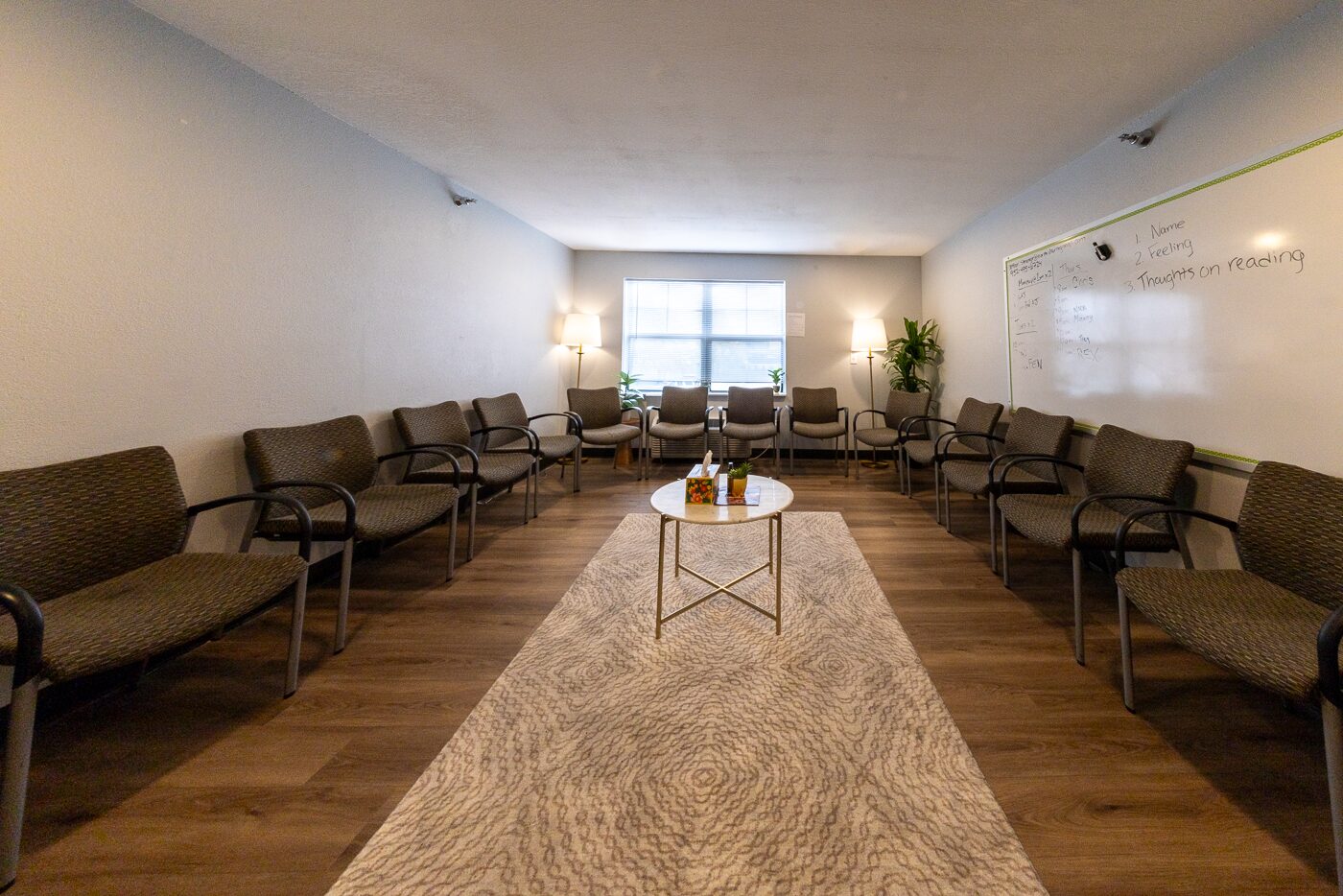
Group Therapy for Addiction Recovery
Addiction convinces people they are uniquely broken, so NorthStar Regional builds every treatment day around group therapy in the Twin Cities, Minnesota. Licensed counselors lead process groups for what is live in the room and education groups that teach sober skills. Mental health groups run alongside addiction groups, since the depression and the drinking are one picture. Residential groups meet daily on separate men’s and women’s campuses, and optional peer-led meetings fill the evenings. We accept Medical Assistance (Medicaid) and most major insurers, and someone across the room has already survived your worst thought.
Group therapy at a glance
Primary and mental health groups
The heavy clinical work first, when minds are freshest. Process groups and dual diagnosis work, led by licensed counselors.
Education and skills groups
Relapse prevention, CBT, trauma skills, handling emotions, and planning for recovery. These are the skills of staying sober, taught and practiced.
Peer-led support meetings
Peer options after dinner: 12-step, SMART Recovery, and more.
Inpatient Rehabilitation
Daily groups on separate men’s and women’s campuses. Part of the full residential schedule.
Licensed Treatment Programs

Founded 2015
Addiction and mental health care in one system

Multiple Campuses
Across the Twin Cities metro

MN Department of Health: Licensed
MN Department of Human Services: Licensed
Understanding the therapy
What Group Therapy Does
“A community for each other.”
The NorthStar Regional brand promise
Addiction is a disease that isolates you. People with addiction come to believe that nobody would understand, that their worst thoughts are theirs alone, and that silence is safety. Group therapy is the clinical answer to that. In a counselor-led circle of people fighting the same fight, your worst thought turns out to be survivable. Someone across the room already survived it, and is sitting there to prove it.
At NorthStar Regional, groups do two jobs. Process groups work what’s live in the room: the craving that showed up this morning, the phone call from home, the resentment that’s been building since intake. Education groups teach the skills: relapse prevention, CBT skills, trauma skills, emotional regulation, recovery planning. Both run daily, led by licensed counselors, with the heavier clinical work in the morning when minds are freshest. Evenings are for peer-led support meetings, including 12-step and SMART Recovery, and none of those are required. Treatment and community are different things. We provide both.

Is this right for you?
Signs Group Therapy Could Help You
Group is where most of treatment happens, and it is the part people resist hardest, right before they need it most. See if any of this sounds familiar.
You're Certain Nobody Would Understand
That certainty is a symptom of addiction. It usually goes away once you sit in a room full of people who do understand.
You Perform Well One-on-One
You can manage a counselor, a boss, a parent, one at a time. A group is harder to charm, which is exactly why it works.
Isolation Is the Pattern
Using alone, recovering alone, relapsing alone. If secrecy has run through all of it, the treatment has to break it.
Promises Are Easier To Keep In Front Of Others
You keep promises made to a room longer than promises made to yourself. That is not weakness. It is how people are built.
You Learn By Watching Others Do It
Someone three weeks ahead of you handles a craving out loud, and suddenly the skill is real. Groups teach by demonstration.
Family Support Isn’t Enough On Its Own
The people who love you can’t also be your clinical support. Group gives that job to people who are trained to do it.
If even a few of these sound like you, that is reason enough to call. You don’t need to be certain, and you don’t need a diagnosis. A comprehensive assessment will sort out where this fits in your care. Reading this for someone you love? Start with our guide for parents or our guide for spouses and partners.
How It Helps
Group Therapy for Addiction and Mental Health
Groups at NorthStar Regional are built for dual diagnosis care. Mental health groups run alongside primary addiction groups, because the depression and the drinking are part of the same picture. Whatever you bring into group, it has its own page and its own place in the plan.
For Addiction
Every substance we treat is explained on its own page, from the first assessment through sober living.
For Mental Health
At designated NorthStar Regional programs, these conditions are treated together with addiction as co-occurring care, in one plan. Standalone mental health treatment, no substance use diagnosis needed, is available through our outpatient clinic in Shakopee.
What to expect
What a Treatment Day of Groups Looks Like
A normal NorthStar Regional day, built around group.
Primary and Mental Health Groups
The heavy clinical work first, when minds are freshest. Process groups and dual diagnosis work, led by licensed counselors.
Education and Skills Groups
Relapse prevention, CBT, trauma skills, handling emotions, and planning for recovery. These are the skills of staying sober, taught and practiced.
Peer-Led Support Meetings
12-step, SMART Recovery, and other peer options after dinner. Not therapy, and not required. For many, it is the start of a recovery community that lasts beyond treatment.
Where You'll Find It at NorthStar Regional
Groups Run Through Every Program
Group therapy goes on at each level of care, from detox to aftercare.
Residential
Inpatient Rehabilitation
Daily groups on separate men’s and women’s campuses. Part of the full residential schedule.
Outpatient
Intensive Outpatient and Virtual IOP
About nine hours of group work a week at outpatient rhythm, in person or from home.
The long game
Outpatient and Relapse Prevention
One day a week of group, individual, and mental health sessions. It keeps group support in your life for six to eight months or longer.
Treatment Options
Explore Our Addiction and Mental Health Therapies and Services
Recovery rarely rests on one method. Below are the addiction and mental health therapies and services at NorthStar Regional. Each has its own page. Your comprehensive assessment, the full evaluation that sets your plan, decides which mix of therapies your plan starts with.
Who's behind the work
About NorthStar Regional
NorthStar Regional is Minnesota’s treatment system built around access: alcohol and drug treatment centers and mental health care across multiple Twin Cities metro locations. Founded in 2015, we provide one connected continuum: detox (withdrawal management), residential, outpatient, mental health, and a sober housing pathway. Separate men’s and women’s campuses, co-occurring care at designated programs, and no faith requirement set us apart. We accept Medical Assistance (Medicaid) and most major insurers, and if you are uninsured, our admissions team helps you through enrollment. A person can walk in with nothing and leave with everything they need to build a life.
Paying for Care
Insurance and Payment Options
Our team helps review your benefits and handles the paperwork with you. If you have no insurance, we help walk you through enrolling for benefits. County case managers, probation officers, hospitals, and crisis teams send clients to us because, in their words, we just get it done.

Insurance and State Funding
Commercial plans, Medical Assistance (Medicaid), county placements, and private pay. We verify benefits and handle the paperwork with you.
We Are Here to Help
We help review your benefits, find your right starting point, and schedule you for the same day or the next whenever possible. Then we pick you up anywhere in the Twin Cities metro.


How Admission Works
What Happens From Your First Call to Your First Night
You did the hard part when you picked up the phone. Here is exactly what happens next, so nothing about day one is a mystery.
You Call and a Real Person Answers
A real person answers, usually within seconds, and asks one short question: substance use, or mental health? There is no phone tree, and you don’t have to tell your life story. We ask only what we need and handle the rest.
We Help with the Details
Our team helps review your benefits, and a short screening covers withdrawal risk, medical needs, and mental health, so you land at the right level of care. Then we schedule you, same day or next day whenever possible.
We Pick You Up
You get reminder calls and texts before pickup. For residential, your admissions coordinator and your driver also call you together, so you know who’s coming, what car to look for, and when to expect them. Many of our drivers are in long-term recovery themselves, and yours will help with your bags.
A Real Person Meets You When You Arrive
Your driver walks you inside and introduces you by name to the team member waiting for you. Your intake team completes your application with you. If you’re hungry, there’s a meal waiting. From there, treatment starts, and we help take care of the logistics along the way.

“The client has done the hard work by picking up the phone. We will carry them the rest of the way.”
Sarah Roy, Executive Vice President
Reviews from Google
Why Clients Choose NorthStar Regional
Don’t just take our word for it. Here is what alumni say about their time in treatment.
Keep reading
Related Articles and Resources

Resources
Before You Call
How admissions works, guides for families, and the forms you can complete early. More resources are linked throughout the site, or contact admissions and we’ll send anything by email.
Questions we hear every day
Common Questions About Group Therapy
What is group therapy?
Group therapy is structured therapy led by a licensed counselor with a small group of peers in treatment. Process groups deal with what is happening in the room, while education groups teach the skills recovery depends on. It is the core of daily addiction treatment at NorthStar Regional.
Do I have to share in group?
No. You’ll be invited to share, but never forced. Many people feel ready sooner than they expect, often because someone else in the group has been through what they were afraid to say out loud. You can take part at your own pace.
Is group therapy the same as a 12-step meeting?
No. Group therapy is clinical treatment led by a licensed counselor. Peer-led support meetings, including 12-step and SMART Recovery, run in the evenings alongside treatment, and none of them are required. You get both, and they do different jobs.
Are groups separate for men and women?
At the residential level, yes. Men’s and women’s programs run on separate campuses. Outpatient groups are co-ed at the right levels of care.
Will insurance cover group therapy?
Yes. Group therapy is covered as part of treatment through Medicaid (Medical Assistance) and most major insurers. Our team helps review your benefits.
Admissions
Make the First Call and We'll Take It from There
Confidential, no obligation, and answered by someone who knows what you’re facing and cares to listen.