

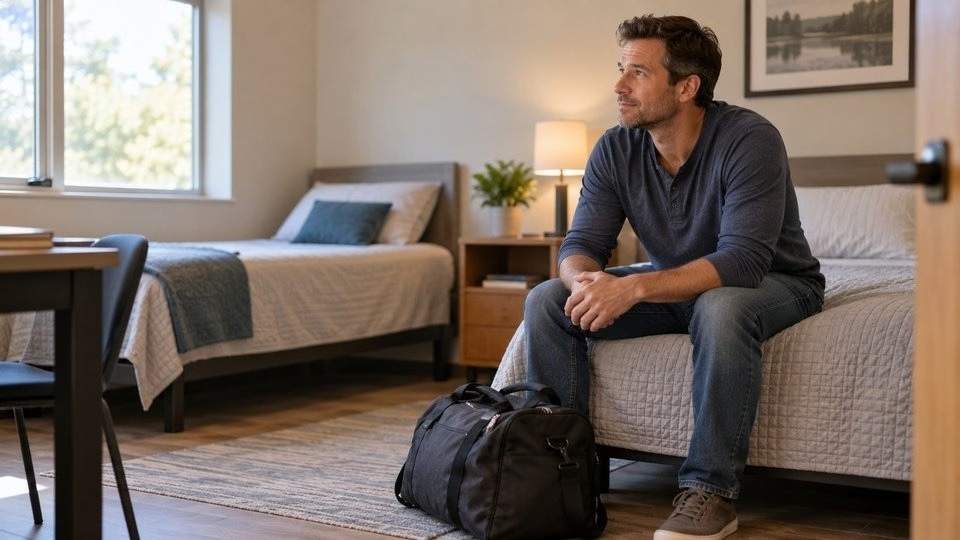
Residential treatment means living at the program while you get treated. That is the whole definition. Everything else is detail.
The detail matters, because Minnesota currently recognizes three residential substance use treatment levels, 3.1, 3.3, and 3.5, with different amounts of clinical intensity and support behind them. Withdrawal management at Levels 3.2 and 3.7 is regulated separately. One number surprises people immediately: Level 3.1 requires at least five hours of psychosocial treatment per week in Minnesota, while adult Level 2.1 intensive outpatient treatment requires nine to 19 hours [1].
NorthStar Regional runs a residential treatment program. This chapter explains what each level actually provides and how to tell which one an assessment is pointing at.
What Residential Treatment Is
Residential treatment is licensed clinical substance use disorder care delivered in a live-in setting. In Minnesota, when a license holder provides treatment and room and board at the same site, a responsible staff member must be on duty 24 hours a day [5]. That does not mean formal therapy runs around the clock. Clinical intensity varies by residential level, and at Level 3.1 the minimum psychosocial-treatment requirement is only five hours per week [1]. The rest of the residential environment provides structure, support, and opportunities to practice recovery skills outside scheduled clinical sessions.
That live-in clinical setting separates residential treatment from outpatient levels, including iop with lodging, where the clinical service remains outpatient even when room and board is provided.
Is Residential the Same as Inpatient?
In everyday speech, yes. In clinical and billing language, not quite.
- Inpatient usually means a hospital or a medically managed setting with physicians on site
- Residential usually means a licensed, non-hospital, home-like environment with 24-hour staffing
- Rehab is the everyday word that covers both, plus outpatient care
Most people searching for inpatient treatment or inpatient rehab are describing residential treatment. The chapter on what is rehab maps how the terms line up across the whole continuum.
Minnesota’s Residential Levels and Separate Withdrawal Management Level
Minnesota currently uses an ASAM Third Edition-aligned statutory framework, even though ASAM Fourth Edition is available and providers may incorporate parts of it [5]. Under Minnesota’s current system, licensed residential SUD treatment includes Levels 3.1, 3.3, and 3.5. Level 3.7 is currently regulated separately as medically monitored withdrawal management under chapter 245F [1].
ASAM level Minnesota classification Minnesota requirement 3.1 Clinically managed low-intensity residential At least 5 hours of psychosocial treatment services per week [1] 3.3 Clinically managed population-specific high-intensity residential 24-hour staffing; daily psychosocial treatment seven days a week; specialized for significant traumatic brain injury or cognitive impairment [1] 3.5 Clinically managed high-intensity residential 24-hour staffing; daily psychosocial treatment seven days a week [1] 3.7 Medically monitored withdrawal management Governed under Minnesota chapter 245F rather than treated as another ordinary residential-treatment level [1]
The Number That Surprises People
Read the 3.1 row again. Five hours a week.
Now compare it to intensive outpatient, ASAM level 2.1, where the same Minnesota statute requires adults to receive nine to 19 hours of psychosocial treatment services per week.
A person in residential treatment at level 3.1 can be receiving less required clinical time than a person in what is iop who sleeps at home.
Why the Hours Are Lower
This is not a loophole. It reflects what Level 3.1 is designed to provide.
Low-intensity residential care combines professionally directed treatment with a 24-hour structured living environment. Minnesota requires at least five hours of psychosocial treatment each week [1], while the residential setting provides additional structure, stability, and opportunities to practice recovery skills between formal sessions.
That means the weekly treatment-hour number does not tell you everything about a Level 3.1 program. Ask:
- How many clinical treatment hours the program actually schedules, not only the statutory minimum
- What structured services and recovery activities fill the rest of the week
- Who is on duty overnight and what responsibilities those staff members have
- How progress, continued stay, and readiness to step down are assessed
Two Level 3.1 programs can structure their weeks very differently while meeting the same minimum requirement, so compare the actual services rather than relying on the ASAM number alone.
What ASAM Level 3.1 Provides
Low-intensity residential treatment is built for people whose clinical needs are manageable but whose living environment is not. The clinical services are real but modest; the supportive environment is the bulk of what the level provides.
The Clinical Side
The clinical team is smaller than at higher levels, and its focus is narrower.
- Individual counseling with an assigned counselor
- Group therapy covering relapse prevention and the recovery skills people actually use at home
- Psychoeducation about substance use disorders and what maintains them
- Treatment planning and regular review of progress
- Medication management, including initiation or titration of addiction and psychiatric medication
- Case management and discharge planning
The Living Side
The residential environment provides the structure that distinguishes Level 3.1 from outpatient care. Depending on the program, that may include:
- 24-hour responsible staffing in the live-in treatment setting
- A structured daily routine, which may include meals, chores and curfews
- Life-skills practice such as cooking, budgeting and keeping appointments
- Peer interaction and recovery support
- Recovery meetings or other structured activities
- Drug and alcohol testing according to program policy
Some programs also use gender specific addiction treatment in their residential settings. The point is not that ordinary routines replace clinical care. It is that Level 3.1 combines lower-intensity clinical treatment with a stable environment where recovery skills can be practiced repeatedly.
A Typical Weekday
Schedules vary, but the shape is consistent across residential treatment programs.
| Time | What happens |
|---|---|
| Morning | Wake, chores, breakfast, community meeting |
| Late morning | Group therapy or psychoeducation |
| Afternoon | Individual counseling, case management, work or school for some residents |
| Early evening | Dinner, life skills practice, free time |
| Evening | Support group or house meeting, then curfew |
Residential Treatment for Mental Health and Co-Occurring Disorders
Not every residential program has the same clinical scope. Some focus primarily on substance use disorders, some are mental health residential programs, and some are designed to address co-occurring conditions. The licensing, staffing, and clinical requirements depend on which services the program is authorized to provide, so it is important to ask exactly what mental health care is available rather than relying on the phrase “dual diagnosis.
Co-Occurring Care
Mental health conditions are common among people receiving substance use disorder treatment, so a good assessment has to look for both. Treating the substance use problem while ignoring a significant mental health condition can make care harder to sustain.
The ASAM Criteria Fourth Edition expects adult SUD programs at every level to be at least co-occurring capable [4]. That does not mean every residential program has psychiatrists and mental health clinicians on site. Co-occurring capable programs are expected to identify and address common mild-to-moderate mental health needs, integrate those needs into the treatment plan, and coordinate with outside mental health providers when needed. More severe or complex psychiatric conditions may require a co-occurring enhanced level of care. Ask what the program treats directly, what it refers out, and how those providers communicate.
Mental Health Residential Programs
Separately, there are residential treatment programs built primarily for mental health issues rather than substance use: severe depression, psychosis, eating disorders, and similar conditions. These are licensed and staffed differently.
If both are present, ask directly which condition the program is licensed to treat as the primary focus. Being placed in a program built for the other disorder wastes the episode.
Residential Treatment vs. Sober Living and Recovery Housing
These get confused constantly, but the difference is more than the building or the job title of the person on duty.
A typical sober living home or recovery residence provides an alcohol- and drug-free living environment, house rules, peer accountability, and varying amounts of recovery support. It is not automatically a licensed clinical treatment program, and residents may receive counseling or IOP from a separate provider.
Level 3.1 is clinical residential treatment. ASAM Fourth Edition also recognizes Clinical Recovery Residences, or Type C residences, as a specific subtype that can be equivalent to social-model Level 3.1 care [3]. Other recovery-residence types are not the same as Level 3.1.
The better questions are:
- Is this location licensed to provide clinical substance use disorder treatment?
- Will I have an individual treatment plan managed by a treatment provider?
- Which clinical services are delivered here and which are provided by outside clinicians?
- Is the housing a treatment program, a Clinical Recovery Residence or a nonclinical recovery residence?
Medication prescribing is not a reliable dividing line. A Level 3.1 program may coordinate medication initiation or titration with outside medical providers rather than prescribing on site [3].
Who Low-Intensity Residential Treatment Fits
The assessment decides, not the website. Minnesota currently uses a six-dimension ASAM framework to evaluate withdrawal risk, medical and psychiatric needs, readiness, continued-use risk, and the recovery environment. Certain patterns may make Level 3.1 more likely, but none of them determines placement by itself.
- A home environment that substantially undermines recovery
- Difficulty functioning effectively in the current living environment
- A need for a staffed residential structure while clinical treatment needs remain relatively low in intensity
- A step down from higher-intensity residential care when continued residential support is still needed
- Previous treatment history showing that environmental or continued-use risks need more structure
- Limited recovery support combined with other needs that make ordinary outpatient care insufficient
Housing instability alone does not automatically mean someone needs clinical residential treatment; depending on the assessment, outpatient care paired with recovery housing may be enough. If medical or psychiatric acuity is the main problem, a medically managed or hospital level may be more appropriate. The chapter on inpatient vs outpatient rehab covers that distinction.
The Disadvantages Nobody Advertises
Every program page lists the many benefits of residential treatment. Fewer list the costs, and they are real.
You Leave Your Life for a While
Jobs, children, school, and pets do not pause. Residential treatment requires arranging all of it, and for some people that arrangement is harder than the treatment.
If stepping away is the obstacle rather than the clinical need, the chapter on online rehab covers the remote alternative.
The Transition Back Is the Risky Part
Structure handed to you is not the same as structure you built, and recovery support has to survive the move. Coming out of a residential program into an unchanged apartment is where a lot of progress gets lost.
Cost and Coverage Can Be More Complicated
Residential treatment generally carries higher total costs than outpatient care because it includes a live-in setting and around-the-clock staffing. Insurance coverage varies by plan, and residential care may require prior authorization, continued-stay reviews, or documentation showing that the level remains medically necessary. Verify benefits and the authorization process before admission so you know what the insurer requires and what costs may remain your responsibility.
A Structured Environment Can Mask Readiness
Doing well inside a program with no access to substances tells you less than doing well at home. Good programs build in passes and real-world practice for exactly this reason.
How Long Residential Treatment Lasts
There is no fixed number, and any program quoting one before assessing you is selling rather than assessing.
Short-term stays run a few weeks. Longer ones run a few months. Low-intensity residential often lasts longer than high-intensity, because the focus is stability rather than stabilization.
Length of stay is driven by progress, the treatment plan, and what funding authorizes. Short-term programs suit people who already have a stable place to return to.
The chapter on how long is rehab covers the full picture, including why a fixed 30-day model persists despite no clinical basis for it.
What Happens After Residential Treatment

Discharge planning should start in week one, not the final week. A step down usually includes some combination of:
- A lower level of care, often what is iop or standard outpatient therapy
- Ongoing therapy and medication management with a community provider
- Housing that is already arranged, whether sober living, family or independent
- Support groups and peer connections in the local community
- More support at home than existed before, including family who have been through the program’s education sessions
- A written relapse prevention plan with names and numbers on it
Ask any program how it handles the handoff. A program that cannot describe its aftercare and ongoing support in specifics has not thought about it, and the weeks after discharge are when recovery is most fragile.
How Residential Treatment Supports Long-Term Recovery
The point of a residential stay is not the stay. It is what it makes possible afterward.
Building a Stronger Foundation
Time in a safe environment does something outpatient care cannot. It interrupts the pattern long enough for a person to think clearly, and that is when the real work becomes possible.
Residents rebuild stability in small, unglamorous ways, and recovery is made of those. Sleeping normally. Eating regularly. Keeping commitments. Those habits are the foundation everything else sits on.
Healing Takes Time
Recovery is not only about stopping. Healing the damage underneath it takes longer than any program lasts: damage to the body, to relationships, to a person’s sense of themselves.
That is why overall well-being, and not abstinence alone, is what a good treatment plan tracks. Progress in sleep, mood, work, and family life all count, and the pace depends on the individual’s condition rather than a schedule.
Family Involvement
Family involvement improves outcomes, and most programs build it in through scheduled sessions and education for relatives. Addiction damages the people around it, and a loved one who understands what is happening becomes ongoing support rather than another source of stress.
Personal Responsibility and Life Skills
A structured and supportive environment is not the same as being managed. Good programs shift personal responsibility onto residents as they progress, because the goal is someone who can maintain a routine with no staff in the building.
Education about the condition itself matters too. Understanding how substance use changes the brain gives people something more useful than willpower to work with, and that understanding carries into long term recovery.
Which ASAM Edition Your Assessment Uses
Worth knowing, because Minnesota has not fully moved to ASAM Fourth Edition yet.
The Fourth Edition adult criteria were released in 2023, and the adolescent and transition-aged youth volume followed in 2026. Major Fourth Edition changes include the new Level 1.0 for long-term remission monitoring, integration of medically managed and withdrawal services into the main continuum, removal of adult Level 3.3, and co-occurring capable standards across all levels [4].
Minnesota is still different. DHS currently states that Minnesota statutes remain aligned with ASAM Third Edition and that Utilization Management reviews are still based on Third Edition requirements [5]. That is why Minnesota statute continues to use Level 3.3 and separately describes withdrawal-management Levels 3.2 and 3.7 even though the current Fourth Edition adult continuum is organized differently. Providers may begin integrating Fourth Edition practices, but they still have to meet Minnesota’s current statutory requirements.
The hour requirements in section 254B.19 therefore do not change automatically just because ASAM publishes a new edition. If an assessment, insurer, and program appear to be using different terminology, ask which ASAM edition each one is applying.
Common Questions About Residential Treatment
Is Residential Treatment the Same as Inpatient Rehab?
Not in formal current ASAM terminology. Residential treatment is Level 3 care delivered in a live-in treatment setting, while the ASAM Fourth Edition uses “inpatient” for hospital-level Level 4 care. Minnesota still operates under a Third Edition-aligned statutory framework, so some older terminology remains in state law, particularly around Level 3.7 withdrawal management. In everyday conversation, people still commonly use “inpatient rehab” to mean residential treatment.
What Is a 3.1 Recovery House?
ASAM Level 3.1 is clinically managed low-intensity residential treatment, not simply another name for a sober living house. In Minnesota, it is licensed residential treatment with at least five hours of psychosocial treatment per week [1], and a same-site residential treatment program has a responsible staff member on duty around the clock [5]. ASAM Fourth Edition also recognizes a specific Clinical Recovery Residence, Type C, that can be equivalent to social-model Level 3.1 care, but ordinary peer-run or monitored sober housing is not Level 3.1 treatment [3].
How Long Do You Stay in Residential Treatment?
It depends on clinical progress, continued-stay needs, the treatment plan, and coverage rather than one universal number. Residential episodes can range from weeks to months depending on level and program. At NorthStar Regional, the current high-intensity residential program is described as lasting up to six weeks, while low-intensity residential is described as approximately three to four months based on individual need. Those ranges are specific to NorthStar rather than ASAM requirements.
What Are the Disadvantages of Residential Treatment?
Residential treatment means stepping away from ordinary work, family, and daily routines for a period of time. It generally costs more than outpatient care, coverage may require prior authorization or continued-stay review, and the eventual transition back into the community needs careful planning. The highly structured environment is one of residential treatment’s strengths, but recovery skills still have to transfer to less structured settings after discharge.
What Is High Intensity Residential Treatment?
ASAM levels 3.3 and 3.5. Minnesota requires daily treatment services seven days a week and 24-hour staffing at both. Level 3.3 is population-specific, designed for people who need a slower pace, often due to cognitive impairment or brain injury.
Choosing Between Levels Without Guessing
Residential treatment is not a more serious version of outpatient treatment. It is a different tool, and at level 3.1 the tool is a stable, safe environment rather than more therapy.
What every level shares is the same aim: enough structure and support, for long enough, that recovery has somewhere to take hold.
Start with a comprehensive assessment. Then ask any program you are considering three questions: how many hours of clinical services it schedules, what its aftercare and ongoing support look like in practice, and how it decides you are ready to leave.
NorthStar Regional’s residential treatment team can walk through those. The chapter on how to prepare for rehab covers packing; the chapter on phones in rehab covers the rule everyone asks about first; and the chapter on what happens in rehab describes a typical day.
Sources
- Minnesota Statutes 2025, section 254B.19, Substance Use Disorder Level of Care Requirements (ASAM 3.1 at least 5 hours of psychosocial treatment services per week; 3.3 and 3.5 daily services seven days a week with 24-hour staffing; 2.1 nine to 19 hours per week; withdrawal management under chapter 245F). https://www.revisor.mn.gov/statutes/cite/254B.19
- American Society of Addiction Medicine criteria summary, Montana Department of Public Health and Human Services, November 2024 (Level 3.1 provides “24-hour community-based living support and structure” and “a minimum of 5 hours per week of professionally directed treatment services”). https://www.dphhs.mt.gov/assets/MedicaidTribalConsultation/November2024/AmericanSocietyofAddictionMedicineCriteriaNov2024.pdf
- American Society of Addiction Medicine. Policy Rounds: Recovery Residences and the ASAM Criteria, 4th Edition (Level 3.1 programs may treat patients benefiting from initiation or titration of addiction or psychiatric medications; only Clinical Recovery Residences, Type C, are equivalent to Level 3.1). https://downloads.asam.org/sitefinity-production-blobs/docs/default-source/advocacy/policy-rounds/recovery-residences-and-asam-criteria-policy-round.pdf
- The ASAM Criteria Fourth Edition summary, Colorado Department of Health Care Policy and Financing (released in four volumes beginning with adults; new Level 1.0 for long-term remission monitoring; withdrawal management integrated into levels; co-occurring capable standards across levels). https://hcpf.colorado.gov/sites/hcpf/files/ASAM-Fourth-Ed-Disseminate-Summary.pdf
- Minnesota Department of Human Services. ASAM Resources for Minnesota SUD Treatment Providers. Current 2026 guidance stating that Minnesota statute remains aligned with ASAM Criteria Third Edition and that Fourth Edition implementation is planned for the future. https://mn.gov/dhs/partners-and-providers/policies-procedures/alcohol-drug-other-addictions/asam-resources-for-minnesota-sud-treatment-providers/asam-resources.jsp
- 6. Minnesota Statutes §245G.10, subdivision 3. Requires a license holder providing treatment and room and board at the same site to have a responsible staff member on duty 24 hours a day. https://www.revisor.mn.gov/statutes/cite/245G.10